
Don’t assume you’re secure.
Prove it.
Red6 tests your authorized environment like an attacker. Find the paths that work. Get the evidence. Know what to fix.
Continuous. Autonomous. Evidence-backed.Illustrative validation sequence. Authorized testing only.
Red6 tests a public application and exposed service. One branch is blocked by an existing control. An alternate route through identity and an internal service reaches a sensitive system. Red6 captures evidence and confirms the attack path.
Vulnerable isn’t the same
as exploitable.
Scanners flag weaknesses. Pentests capture a moment. Your environment keeps changing. Can an attacker get through today?
Scanner results
Potential attack paths
Theoretical risk
Validated paths
Evidence captured
Impact demonstrated
Map the possible paths.
See the environment
an attacker sees.
See how assets, services and findings connect. Choose what to investigate next.
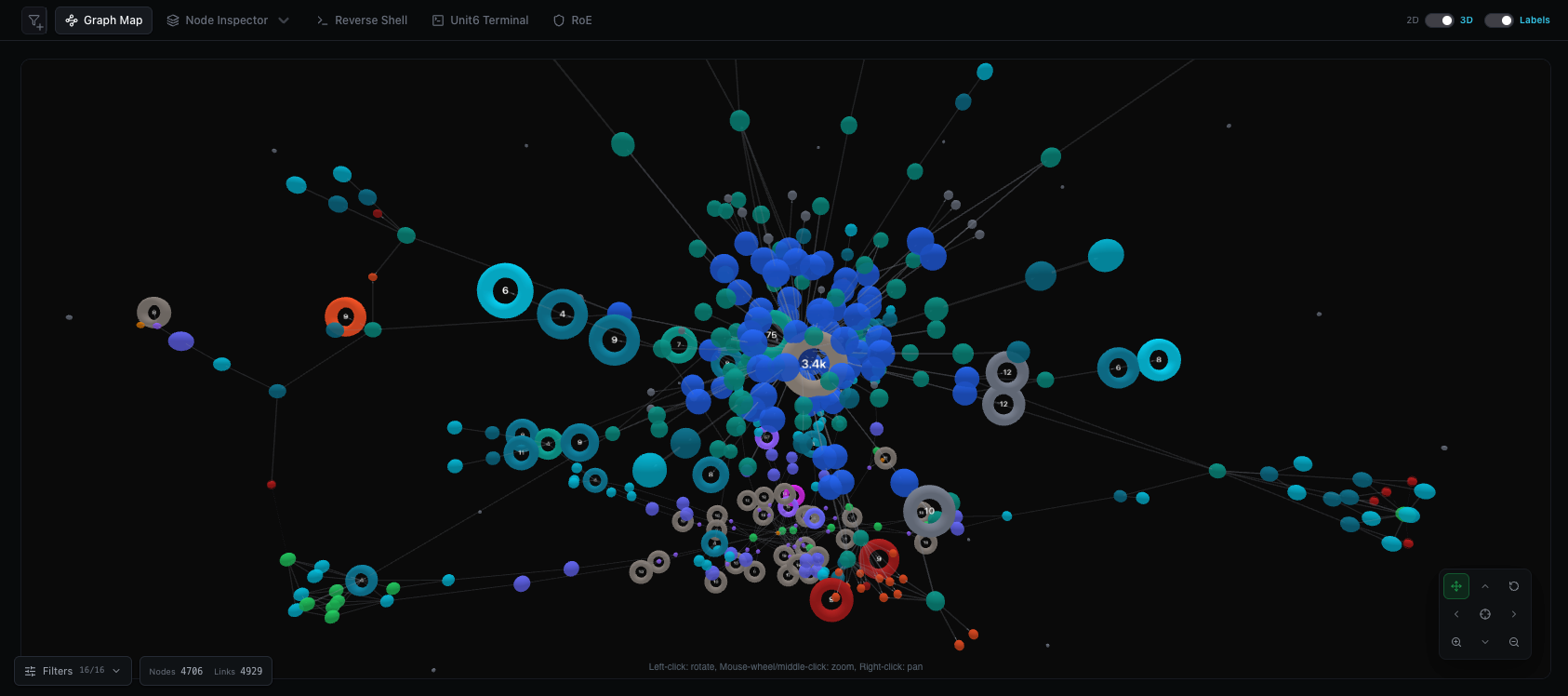
a question to investigate.
Trace the connections between domains, services and findings.
Product view · example workspaceThe map shows how the environment connects.
Testing establishes what those connections enable.
Reconnaissance is
only the beginning.
From exposed assets to targeted checks. One configurable pipeline.
Discover
Enumerate
Recon
Analyze
Correlate
Validate
Bring subdomain discovery and passive sources into one starting picture of the authorized environment.
Illustrated pipeline · select a stageGive Red6 the objective.
Define how it operates.
Set the objective and scope. Red6 investigates and adapts. Your team can steer, approve or stop the run.
Build repeatable workflows from recon to evidence and reporting.
Autonomous doesn’t mean uncontrolled.
Defined scope
Choose project targets and the environment you are authorized to test. Reconnaissance stays tied to that scope.
Choose the stages. Set the scope. Keep the evidence.
Give your red team
more room to go deeper.
Automate repeatable work. Keep your people on novel paths, business logic and deeper investigation.
Keep testing between assessments.
Schedule discovery. Review changes. Test priority exposures within scope.
Repeatable coverage alongside formal assessments.Keep people on the hard problems.
Spend less time on recon setup. Keep control of objectives, approvals and deeper investigation.
More time for the paths that need a human.Give remediation a reason.
Prioritize demonstrated risk. Give owners evidence. Retest supported fixes.
Priorities backed by evidence.Make each engagement a starting point.
Carry context and evidence between engagements. Revisit exposure with repeatable workflows.
Continuity for teams working with testing partners.Evidence over
assumptions.
A possible path needs testing. A demonstrated path needs action.
See what ran, what happened and what to fix.
“Did we find something?”
“What did we actually demonstrate?”The configured proof was observed.
The check returned the expected proof marker. The record preserves the target, observation and evidence references.
- Scope
- Authorized test service
- Validation
- Operator-approved, allowlisted check
- Observation
- Expected proof marker returned
- Next decision
- Review the evidence and remediation priority
Security changes.
Your testing should too.
New assets. New exposure. Test again, fix what matters and verify the change.
New service discovered
Find what changed.
- Observation
- New HTTPS service
- Scope
- api.acme.example
- Next step
- Review the exposed endpoint
Run manually, on a configured schedule, or from supported monitoring events.
Supported demonstrated checks can be retested in their original scope, with closed, still-open or inconclusive results recorded.
See the path for
your next decision.
What worked? What needs fixing? Did the fix hold? See the evidence in one view.
3 demonstrated paths need attention
Illustrated Insights view with fictional data. Not a customer assessment.
Separate evidence from possibility.
See demonstrated paths alongside theoretical relationships and the recorded testing activity.
Connect risk to remediation.
Review the supported findings and the work linked to demonstrated paths.
Look for verification.
Follow scoped retest results, verified closure and regressions as the evidence changes.
STOP WONDERING.
Prove it.
See what works against your environment. Know what to fix next.
Red6 proves your side.
Intel6 shows you theirs.
Intel6 reveals relevant attacker activity. Use that context to decide what Red6 should test.
Intel6
What are they preparing to do?
- Adversary activity
- Targeting & infrastructure
- Access & customer context
→ TEAM ACTION
Red6
Would it actually work?
- Environment & attack paths
- Authorized validation
- Evidence & scoped retesting
Intel6 connects attacker activity to your organization.
Adversaries change. Your environment changes. Bring the next question back into the loop.
Intel6 works independently.
Red6 works independently.
Together, connect what they’re preparingwith what works against your environment.